
Background: Melasma and facial skin aging are multifactorial conditions involving pigmentary, inflammatory, vascular, and dermal remodeling pathways. Combination energy-based device (EBD) protocols are designed to target multiple pathways in a single treatment course. However, real-world data on focused ultrasound and radiofrequency (RF) microneedling combined with exosome delivery, for managing melasma and facial skin aging are limited. Case Presentation: This is a retrospective, single-center case series of four patients aged 50 to 60 years with Fitzpatrick skin phototypes III to IV, presenting with mixed-type melasma, and facial skin aging. During the first session, each patient received dot-mode focused ultrasound (LinearZ) followed 30 minutes later by monopolar RF microneedling (POTENZA) with 1.5 mL of a bacteria-derived extracellular vesicle solution (RexoFace). Patients subsequently received one or two additional RF microneedling sessions at 6-week intervals. Thus, the interval from baseline to the final 4-week post-treatment assessment was approximately 10 weeks for patients receiving two RF sessions and 16 weeks for the patient receiving three RF sessions. Outcomes were assessed descriptively on standardized clinical photographs and images obtained with the Sylton OBSERV 520x imaging platform at baseline and 4 weeks after the final session. All four patients showed investigator-assessed improvement in melasma pigmentation, skin quality, and clinical signs of facial aging. Assessment was unblinded and no validated severity instrument was applied. Mild to moderate erythema with edema followed each RF microneedling session and decreased without intervention within 45 minutes. No serious adverse events, scarring, infection, or post-inflammatory hyperpigmentation were recorded during the 4-week observation period. Since the follow-up was limited to 4 weeks after the final session, these observations do not establish medium-term cutaneous safety or durability. Conclusions: In this retrospective four-patient case series, the combined protocol of dot-mode focused ultrasound and monopolar RF microneedling with a bacteria-derived extracellular vesicle solution was associated with visible improvement and was well tolerated over a short observation period.
| Published in | International Journal of Clinical Dermatology (Volume 9, Issue 2) |
| DOI | 10.11648/j.ijcd.20260902.14 |
| Page(s) | 132-139 |
| Creative Commons |
This is an Open Access article, distributed under the terms of the Creative Commons Attribution 4.0 International License (http://creativecommons.org/licenses/by/4.0/), which permits unrestricted use, distribution and reproduction in any medium or format, provided the original work is properly cited. |
| Copyright |
Copyright © The Author(s), 2026. Published by Science Publishing Group |
Melasma, Skin Aging, Radiofrequency Microneedling, Extracellular Vesicles, Focused Ultrasound, Fitzpatrick Skin Phototype III-IV, Vietnam, Case Series
S. No. | Patient demographics | Skin condition at baseline | Treatment modality | |
|---|---|---|---|---|
LinearZ | POTENZA × RexoFace (Exosome) | |||
1 | Female, 50 years | Fitzpatrick type IV Mixed type melasma Skin aging (wrinkles and sagging) Overall decline in skin quality parameters | Number of Sessions: 1 Depth: 1.5 mm Mode: Dot Energy: 0.2 J 100 lines per side (melasma area) | Number of Sessions: 2 +Session 1: Tip S-25 combined with 1.5 mL of RexoFace (Renvix Science). Depth: 1.25 - 2.0mm Energy 700 mJ/pulse, 1MHz & 2MHz, monopolar, mid and lower face, 4 passes. +Session 2: Tip CP-21 combined with 1.5 mL of RexoFace (Renvix Science). Depth: 0.5 -2.0mm Energy 200 mJ/pulse, 1 MHz, monopolar, full face, 3 passes. |
2 | Female, 60 years | Fitzpatrick type III Mixed type melasma Skin aging (wrinkles and sagging) Overall decline in skin quality parameters | Number of Sessions: 1 +Depth: 3.0 mm, Mode: Dot, Energy: 0.9 J, 200 lines per side, midface and lower face +Depth: 4.5 mm, Mode: Dot, Energy: 1.1 J, 150 shots per side, lower face. | Number of Sessions: 3 +Session 1: Tip CP-21 combined with 1.5 mL of RexoFace (Renvix Science) Depth: 0.5 - 2.0mm Energy 200 mJ/pulse, 1 MHz, monopolar, mid and lower face, 4 passes. +Session 2: Tip I-25 combined with 1.5 mL of (Renvix Science). Depth: 0.5 - 2.0mm Energy 600 mJ/pulse, 1 MHz &2 MHz, monopolar & bipolar, full face, 3 passes. +Session 3: Tip CP-21 combined with 1.5 mL of (Renvix Science). Depth: 0.5 - 2.0mm Energy 250 mJ/pulse, 1 MHz & 2 MHz, monopolar, full face, 4 passes |
3 | Male, 50 years | Fitzpatrick type IV Mixed type melasma Skin aging Overall decline in skin quality parameters | Number of Sessions: 1 +Depth: 3.0 mm, Mode: Dot, Energy: 0.9 J, 300 lines per side, midface and lower face +Depth: 4.5 mm, Mode: Dot, Energy: 1.1 J, 100 shots per side, lower face | Number of Sessions: 2 +Session 1: Tip S-25 combined with 1.5 mL of (Renvix Science). Depth: 1.25 - 2.5 mm, 1 MHz & 2 MHz, monopolar & bipolar, mid and lower face, 4 passes. Energy 600 mJ/pulse, +Session 2: Tip I-25 combined with 1.5 mL of (Renvix Science). Depth: 0.5 - 2.5mm Energy 500 mJ/pulse, 1 MHz & 2 MHz, monopolar & bipolar, full face, 3 passes. |
4 | Female, 58 years | Fitzpatrick type IV Mixed type melasma Skin aging (wrinkles and sagging) Overall decline in skin quality parameters | Number of Sessions: 1 +Depth: 1.5 mm Mode: Dot Energy: 0.2 J 110 lines per side (melasma area) | Number of Sessions: 2 +Session 1: Tip CP-21 combined with 1.5 mL of (Renvix Science). Depth: 0.5 - 2.0mm Energy 200-300 mJ/pulse, 1 MHz & 2 MHz, monopolar, full face, 3 passes. +Session 2: Tip S-25 combined with 1.5 mL of (Renvix Science). Depth: 1.25 - 2.0mm Energy 600 mJ/pulse, 1 MHz & 2 MHz, monopolar & bipolar, mid and lower face, 4 passes. |
EBD | Energy-based Device |
MHz | Megahertz |
J | Joule |
mJ | Millijoule |
mL | Milliliter |
mm | Millimeter |
RF | Radiofrequency |
| [1] |
International Society of Aesthetic Plastic Surgery (ISAPS). Global Survey 2024: Full Report and Press Releases. Available from:
https://www.isaps.org/discover/about-isaps/global-statistics/global-survey-2024-full-report-and-press-releases/ (accessed 21 August 2026). |
| [2] | Chao, J. R., Porter, J. P., Hessler, J. Cosmetic Treatments with Energy-Based Devices in Skin of Color. Facial Plastic Surgery. 2023, 39(5), 496-500. |
| [3] | Gold, M., Biesman, B., Cohen, J. L., et al. Real-World Experience Using a Multi-Modality System Using Intense Pulsed Light, Radiofrequency Microneedling, High-Intensity Focused Ultrasound, or Thermal Radiofrequency for Skin Rejuvenation Treatment. Journal of Cosmetic Dermatology. 2024, 23(S3), 1-11. |
| [4] | Jurcevic, J., Ceovic, R. A Multimodal Approach to Facial Rejuvenation: Integrating HA Fillers, Collagen Stimulators, Botulinum Toxin and Energy-Based Devices for Optimal Patient Outcomes. Journal of Aesthetic Medicine. 2026, 2(1), 3. |
| [5] | Naharro-Rodriguez, J., Bacci, S., Hernandez-Bule, M. L., Perez-Gonzalez, A., Fernandez-Guarino, M. Decoding Skin Aging: A Review of Mechanisms, Markers, and Modern Therapies. Cosmetics. 2025, 12(4), 144. |
| [6] | Oku, K. Treatment of Melasma Targeting Dermal-Epidermal Interactions Utilizing High-Intensity, High-Frequency Parallel Ultrasound Beam in Asian Skin. Journal of Cosmetic Dermatology. 2026, 25(4), e70820. |
| [7] | Gu, D., Pan, R., Meng, X., et al. What Lies Behind Melasma: A Review of the Related Skin Microenvironment. International Journal of Dermatology. 2025, 64(2), 256-265. |
| [8] | Kumar, N., Lin, S., Luthra, A., Patel, T., Bhatia, A. C. The Efficacy and Safety of Radiofrequency Microneedling for Melasma: A Systematic Review and Qualitative Evidence Synthesis. Aesthetic Surgery Journal Open Forum. 2026, 8, ojag075. |
| [9] | Malarz, D., Czyżewski, Ł., Olczak-Kowalczyk, D. Microneedle Radiofrequency for Skin Rejuvenation: Bridging Image-Derived Metrics and Photographic Assessment. Frontiers in Medicine. 2025, 12, 1710949. |
| [10] | Imaizumi, A., Fujimaki, A., Kumar, N. A Retrospective Analysis of Radiofrequency Microneedling for Melasma Management in the Japanese Population. Clinical, Cosmetic and Investigational Dermatology. 2026, 19, 601440. |
| [11] | Kim, H. B., Lee, S. Y., Um, J. Y., Baek, S. Y., Kim, H. O., Kumar, N. Clinical Effects and Safety of Radiofrequency Microneedling for the Management of Melasma: A Retrospective Study. Aesthetic Surgery Journal Open Forum. 2026, 8, ojag143. |
| [12] | Li, M., Fang, F., Sun, M., Zhang, Y., Hu, M., Zhang, J. Extracellular Vesicles as Bioactive Nanotherapeutics: An Emerging Paradigm for Regenerative Medicine. Theranostics. 2022, 12(11), 4879-4903. |
| [13] | Dhaliwal, N. K., Moothathamby, T., Sokhal, B. S., Gkini, M. A. The Use of Microneedling with Exosomes in Dermatology: A Systematic Review. Journal of Cosmetic Dermatology. 2026, 25, e70881. |
| [14] | Marquardt, K., Hartmann, C., Wegener, F., et al. Microfocused Ultrasound with Visualization Induces Remodeling of Collagen and Elastin Within the Skin. Journal of Cosmetic Dermatology. 2025, 24(1), e16638. |
| [15] | Vachiramon, V., Pavicic, T., Casabona, G., et al. Microfocused Ultrasound in Regenerative Aesthetics: A Narrative Review on Mechanisms of Action and Clinical Outcomes. Journal of Cosmetic Dermatology. 2025, 24(2), e16658. |
| [16] | Byun, J. W., Kang, Y. R., Park, S., Hong, W. Efficacy of Radiofrequency Combined with Single-Dot Ultrasound for Skin Rejuvenation: A Non-Randomized Split-Face Trial with Blinded Response Evaluation. Skin Research and Technology. 2023, 29(9), e13452. |
| [17] | Wang, R., Peng, G., Chen, Y., et al. Combined Novel Microfocused Ultrasound and Microneedle Fractional Radiofrequency System for Multilayered Facial Rejuvenation: A Prospective, Randomized, and Split-Face Study. Journal of Cosmetic Dermatology. 2025, 24(10), e70455. |
| [18] | Wan, J., Yoon, S. E., Yi, K. H. The Efficacy of Combined Exosome (Exodew) and Microneedling Treatment for Facial Pore Reduction and Skin Texture Improvement. Plastic and Reconstructive Surgery Global Open. 2025, 13(6), e6849. |
| [19] | Biskanaki, F., Varvaresou, A., Papageorgiou, E. G., Protopapa, E., Lazaris, A. C. Digital Skin Analysis of Multimodal Skin Rejuvenation with HIFU and Microneedling-Assisted Exosome/PDRN Delivery: A Pilot Comparative Study. Applied Sciences. 2026, 16(14), 7050. |
| [20] | Cho, B., Bae, K. T., Wan, J., Yi, K. H. Effects of Exosome-Containing Skin Booster and Microneedling Treatment on Facial Aging: A Retrospective Analysis of 40 Cases. Plastic and Aesthetic Nursing. 2026, 46(1), 25-29. |
APA Style
Vo, T. N. (2026). Focused Ultrasound Followed by Radiofrequency Microneedling with Bacteria-derived Extracellular Vesicle for Melasma and Skin Aging: A Retrospective Case Series. International Journal of Clinical Dermatology, 9(2), 132-139. https://doi.org/10.11648/j.ijcd.20260902.14
ACS Style
Vo, T. N. Focused Ultrasound Followed by Radiofrequency Microneedling with Bacteria-derived Extracellular Vesicle for Melasma and Skin Aging: A Retrospective Case Series. Int. J. Clin. Dermatol. 2026, 9(2), 132-139. doi: 10.11648/j.ijcd.20260902.14
AMA Style
Vo TN. Focused Ultrasound Followed by Radiofrequency Microneedling with Bacteria-derived Extracellular Vesicle for Melasma and Skin Aging: A Retrospective Case Series. Int J Clin Dermatol. 2026;9(2):132-139. doi: 10.11648/j.ijcd.20260902.14
@article{10.11648/j.ijcd.20260902.14,
  author = {Trong Nghia Vo},
  title = {Focused Ultrasound Followed by Radiofrequency Microneedling with Bacteria-derived Extracellular Vesicle for Melasma and Skin Aging: A Retrospective Case Series},
  journal = {International Journal of Clinical Dermatology},
  volume = {9},
  number = {2},
  pages = {132-139},
  doi = {10.11648/j.ijcd.20260902.14},
  url = {https://doi.org/10.11648/j.ijcd.20260902.14},
  eprint = {https://article.sciencepublishinggroup.com/pdf/10.11648.j.ijcd.20260902.14},
  abstract = {Background: Melasma and facial skin aging are multifactorial conditions involving pigmentary, inflammatory, vascular, and dermal remodeling pathways. Combination energy-based device (EBD) protocols are designed to target multiple pathways in a single treatment course. However, real-world data on focused ultrasound and radiofrequency (RF) microneedling combined with exosome delivery, for managing melasma and facial skin aging are limited. Case Presentation: This is a retrospective, single-center case series of four patients aged 50 to 60 years with Fitzpatrick skin phototypes III to IV, presenting with mixed-type melasma, and facial skin aging. During the first session, each patient received dot-mode focused ultrasound (LinearZ) followed 30 minutes later by monopolar RF microneedling (POTENZA) with 1.5 mL of a bacteria-derived extracellular vesicle solution (RexoFace). Patients subsequently received one or two additional RF microneedling sessions at 6-week intervals. Thus, the interval from baseline to the final 4-week post-treatment assessment was approximately 10 weeks for patients receiving two RF sessions and 16 weeks for the patient receiving three RF sessions. Outcomes were assessed descriptively on standardized clinical photographs and images obtained with the Sylton OBSERV 520x imaging platform at baseline and 4 weeks after the final session. All four patients showed investigator-assessed improvement in melasma pigmentation, skin quality, and clinical signs of facial aging. Assessment was unblinded and no validated severity instrument was applied. Mild to moderate erythema with edema followed each RF microneedling session and decreased without intervention within 45 minutes. No serious adverse events, scarring, infection, or post-inflammatory hyperpigmentation were recorded during the 4-week observation period. Since the follow-up was limited to 4 weeks after the final session, these observations do not establish medium-term cutaneous safety or durability. Conclusions: In this retrospective four-patient case series, the combined protocol of dot-mode focused ultrasound and monopolar RF microneedling with a bacteria-derived extracellular vesicle solution was associated with visible improvement and was well tolerated over a short observation period.},
 year = {2026}
}
TY  - JOUR
T1  - Focused Ultrasound Followed by Radiofrequency Microneedling with Bacteria-derived Extracellular Vesicle for Melasma and Skin Aging: A Retrospective Case Series
AU  - Trong Nghia Vo
Y1  - 2026/10/26
PY  - 2026
N1  - https://doi.org/10.11648/j.ijcd.20260902.14
DO  - 10.11648/j.ijcd.20260902.14
T2  - International Journal of Clinical Dermatology
JF  - International Journal of Clinical Dermatology
JO  - International Journal of Clinical Dermatology
SP  - 132
EP  - 139
PB  - Science Publishing Group
SN  - 2995-1305
UR  - https://doi.org/10.11648/j.ijcd.20260902.14
AB  - Background: Melasma and facial skin aging are multifactorial conditions involving pigmentary, inflammatory, vascular, and dermal remodeling pathways. Combination energy-based device (EBD) protocols are designed to target multiple pathways in a single treatment course. However, real-world data on focused ultrasound and radiofrequency (RF) microneedling combined with exosome delivery, for managing melasma and facial skin aging are limited. Case Presentation: This is a retrospective, single-center case series of four patients aged 50 to 60 years with Fitzpatrick skin phototypes III to IV, presenting with mixed-type melasma, and facial skin aging. During the first session, each patient received dot-mode focused ultrasound (LinearZ) followed 30 minutes later by monopolar RF microneedling (POTENZA) with 1.5 mL of a bacteria-derived extracellular vesicle solution (RexoFace). Patients subsequently received one or two additional RF microneedling sessions at 6-week intervals. Thus, the interval from baseline to the final 4-week post-treatment assessment was approximately 10 weeks for patients receiving two RF sessions and 16 weeks for the patient receiving three RF sessions. Outcomes were assessed descriptively on standardized clinical photographs and images obtained with the Sylton OBSERV 520x imaging platform at baseline and 4 weeks after the final session. All four patients showed investigator-assessed improvement in melasma pigmentation, skin quality, and clinical signs of facial aging. Assessment was unblinded and no validated severity instrument was applied. Mild to moderate erythema with edema followed each RF microneedling session and decreased without intervention within 45 minutes. No serious adverse events, scarring, infection, or post-inflammatory hyperpigmentation were recorded during the 4-week observation period. Since the follow-up was limited to 4 weeks after the final session, these observations do not establish medium-term cutaneous safety or durability. Conclusions: In this retrospective four-patient case series, the combined protocol of dot-mode focused ultrasound and monopolar RF microneedling with a bacteria-derived extracellular vesicle solution was associated with visible improvement and was well tolerated over a short observation period.
VL  - 9
IS  - 2
ER  -
Department of Dermatology and Aesthetic, Annsthetic Beauty Clinic, Ho Chi Minh City, Vietnam
Biography: Trong Nghia Vo is a Specialist Level I Dermatologist and Lead Physician at Annsthetic Beauty Clinic, specializing in aesthetic dermatology. I graduated with a Doctor of Medicine degree in 2021 and subsequently completed postgraduate training in Dermatology. I have over five years of clinical experience in dermatology and aesthetic medicine, with a particular focus on minimally invasive aesthetic procedures and energy-based dermatological technologies. My clinical interests include skin rejuvenation, pigmentation disorders, acne and acne scars, skin quality improvement, and regenerative aesthetic medicine. I have experience with various energy-based devices, injectable treatments, and combination treatment protocols for facial rejuvenation and skin disorders. My research interests focus on skin regeneration, the skin microbiome, extracellular vesicles, and the integration of energy-based technologies with regenerative strategies. I am actively involved in clinical research, scientific presentations, and international collaborations in dermatology and aesthetic medicine.
Research Fields: Aesthetic dermatology, Skin rejuvenation, Energy-based dermatological technologies, Skin microbiome, Regenerative aesthetic medicine, Pigmentation disorders, Injectable aesthetic treatments

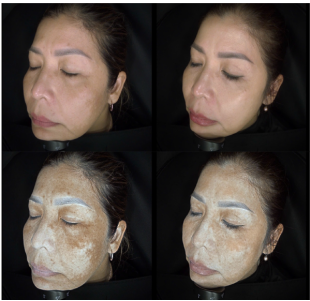
Figure 1. Case 1. Clinical and Sylton OBSERV 520x photographs of a 50-year-old woman at baseline and at 4 weeks after the final treatment session, captured under matched lighting, camera settings, working distance, and head position. Upper panels, clinical photographs; lower panels, Sylton OBSERV 520x images; no post-processing.
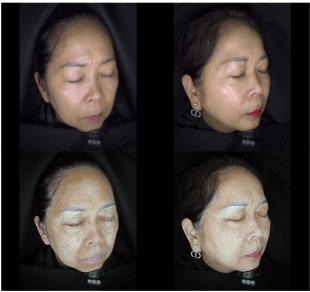
Figure 2. Case 2. Clinical and Sylton OBSERV 520x photographs of a 60-year-old woman at baseline and at 4 weeks after the final treatment session, captured under matched lighting, camera settings, working distance, and head position. Upper panels, clinical photographs; lower panels, Sylton OBSERV 520x images; no post-processing.
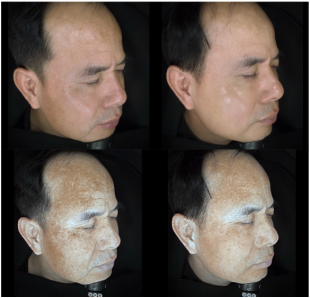
Figure 3. Case 3. Clinical and Sylton OBSERV 520x photographs of a 50-year-old man at baseline and at 4 weeks after the final treatment session, captured under matched lighting, camera settings, working distance, and head position. Upper panels, clinical photographs; lower panels, Sylton OBSERV 520x images; no post-processing.
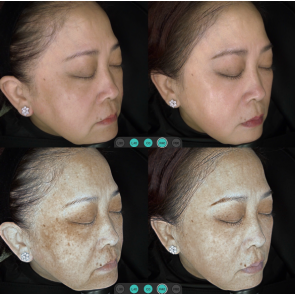
Figure 4. Case 4. Clinical and Sylton OBSERV 520x photographs of a 58-year-old woman at baseline and at 4 weeks after the final treatment session, captured under matched lighting, camera settings, working distance, and head position. Upper panels, clinical photographs; lower panels, Sylton OBSERV 520x images; no post-processing.
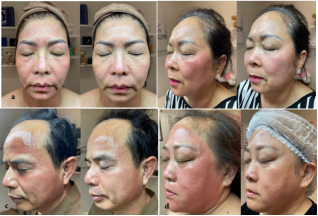
Figure 5. Facial appearance immediately after the combined treatment session (left panel of each pair) and 45 minutes later (right panel of each pair), showing mild to moderate transient erythema and edema that decreased without intervention. (a) Case 1; (b) Case 2; (c) Case 3; (d) Case 4.

Information



 Share This Article
 Twitter
 Linked In
 Facebook

 Copy
 Download